










A Conversation with Erica Farmer
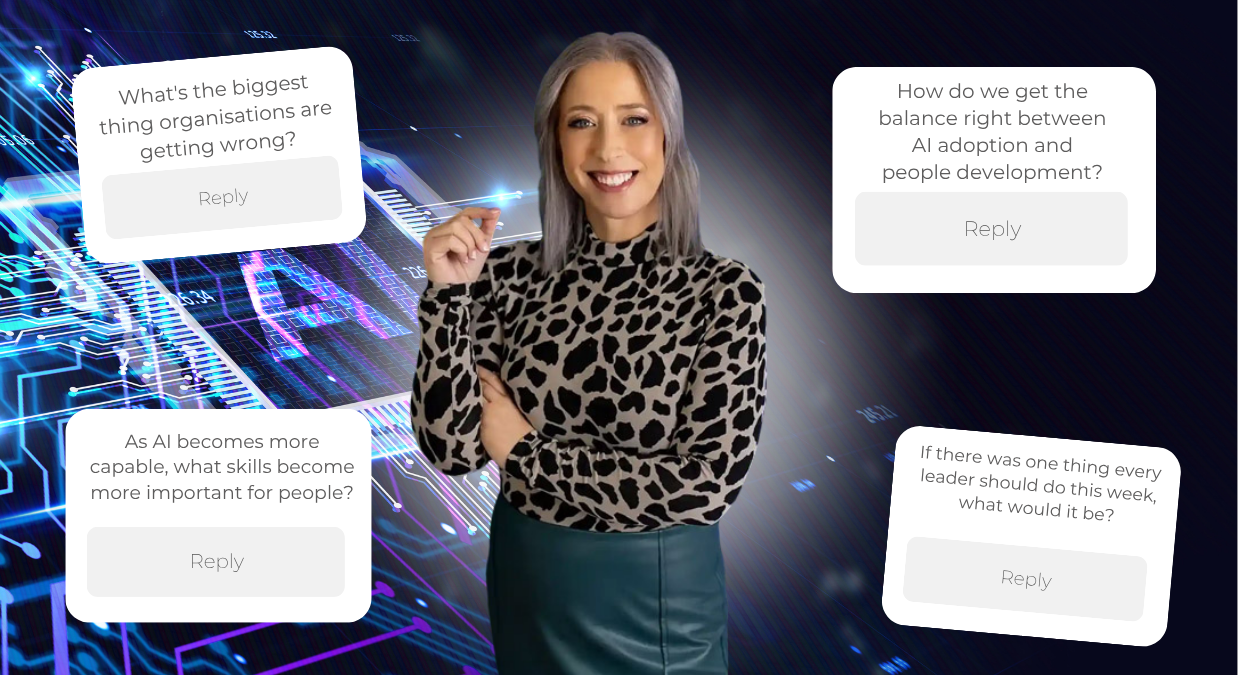
Erica Farmer is an AI strategist, speaker and learning and development expert who helps organisations navigate workforce transformation, leadership development and AI adoption.
AI conversations often focus on tools, productivity gains and implementation strategies. Yet according to AI strategist and learning and development expert Erica Farmer, the organisations making the greatest progress aren’t necessarily the ones with the most advanced technology. They’re the ones paying attention to people.
In this Q&A, we discuss leadership, psychological safety, learning agility, inclusion and why AI is revealing organisational challenges that were often hiding in plain sight.
Q: There’s a huge amount of noise around AI at the moment. What’s the biggest thing organisations are getting wrong?
A: The people piece.
I open LinkedIn far more than I should and, honestly, I’m getting sick of reading posts about AI, despite being one of the people writing about it. What I’ve noticed is that many organisations have skipped over the hearts and minds piece.
We’ve treated AI like another technology deployment, another software rollout, another change programme. But this is fundamentally different. This is closer to an intelligence than it is a traditional technology.
People need time to understand how they feel about it. They need space to process what it means for their role, their future and their organisation. If leaders don’t address those questions directly, people will fill in the gaps themselves. And when uncertainty exists, people naturally create their own narratives.
The organisations that recognise that human reality will be the ones that succeed.
Q: You’ve described AI as a “thought partner” rather than a taskmaster. What do you mean by that?
A: A lot of people start their AI journey by using it to rewrite emails, summarise documents or create meeting notes. That’s fine as a starting point, but it’s very transactional.
It’s like using AI as a vending machine. You put something in, something comes out, and you walk away.
The real value comes when you use AI as a thought partner. Think of it as a digital colleague, coach, tutor or even a devil’s advocate.
One of my favourite things to do is actively ask AI to challenge my assumptions. I want it to test my thinking and offer alternative perspectives. Not because it’s doing the thinking for me, but because it’s helping me stretch my own thinking.
The organisations that will get the most value from AI aren’t simply automating tasks. They’re using it to explore ideas, solve problems and think differently.
Q: As AI becomes more capable, what skills do you think become more important for people?
A: The conversation about skills is absolutely central right now.
I think we’ve created this false choice between humans and machines, as though one has to win. My view is that it’s about humans and AI working together because each brings different strengths.
For me, the key skills are critical thinking, creative thinking and learning agility.
I’ve heard critical thinking and creative thinking together described as “heavy thinking”, and I really like that phrase. We need people who can question assumptions, spot patterns, evaluate ideas and look at problems from different perspectives.
We also need people who can learn quickly.
One of the biggest challenges facing organisations isn’t teaching new skills. It’s helping people let go of old assumptions and adapt to new ways of working without feeling threatened by that change.
The differentiator isn’t whether you’re using AI or not because, increasingly, everybody is. The differentiator is how effectively you use it to create value and innovate.
Q: Have you seen examples of organisations getting the balance right between AI adoption and people development?
A: Absolutely.
One of the best examples comes from a SaaS business I worked with across the UK and US. Before they rolled out any major AI initiatives, the executive team told employees they wanted them to spend one hour every week experimenting with AI.
That was it.
They ring-fenced the time and created permission to learn.
That sends a powerful message. It tells people they can explore. They can fail. They can experiment. They’re not expected to instantly become experts.
What that created was psychological safety, and psychological safety is incredibly important if you want people to embrace change.
Compare that with organisations that simply hand out access to a tool and tell people to get on with it. They might improve individual productivity, but that doesn’t necessarily translate into organisational productivity.
The organisations seeing the strongest results are focusing on culture, behaviours and ways of working, not just technology.
Q: You’ve spoken about leadership throughout this conversation. What separates effective leaders from ineffective ones in the age of AI?
A: Mindset.
The leaders doing well right now are listening. They’re asking questions. They’re experimenting themselves. They’re being vulnerable enough to admit when they don’t know something.
Historically, leaders could set a strategy and leave implementation to everyone else.
AI doesn’t really allow for that.
You’ve got to do the doing. You’ve got to understand the technology. You’ve got to understand how your people feel about it. You’ve got to communicate consistently and openly.
The leaders who struggle are often the ones who either feel threatened by AI and avoid engaging with it, or they’re convinced they’ve already got all the answers.
Nobody has all the answers right now.
This is new territory for all of us.
The strongest leaders are approaching that reality with curiosity rather than certainty.
Q: You’ve written and spoken extensively about gender and AI. Why is that conversation important?
A: Because AI reflects the data, behaviours and systems we already have.
When I attend conferences and events, I still regularly see panels discussing AI that contain very little diversity of thought or representation. That matters.
AI isn’t creating these issues. It’s shining a light on them.
If we continue feeding AI systems data that reflects existing inequalities, we shouldn’t be surprised when those inequalities are reinforced.
This isn’t a women’s issue. It’s an everybody issue.
We need more diverse voices contributing to these conversations. We need more allyship. We need leaders actively helping people build confidence and capability around AI, rather than assuming everybody starts from the same place.
If we want AI to benefit society as a whole, society as a whole needs a seat at the table.
Q: If there was one thing every leader should do this week, what would it be?
A: Sit down and honestly ask yourself how you feel about AI.
That sounds like a simple question, but it isn’t.
How does it make you feel about your role? Your career? Your organisation? Your responsibilities as a leader?
Because AI is changing all of those things.
The leaders who are succeeding are the ones who have spent time reflecting on those questions. They’ve embraced curiosity. They’ve accepted uncertainty. They’ve recognised that nobody has a complete roadmap.
The leaders who avoid those conversations are often making things harder for themselves and their teams.
This isn’t just a technology shift.
It’s a human shift.
Q: Finally, organisations are investing heavily in AI training. What’s your advice?
A: AI literacy is essential, but it’s only one piece of a much bigger puzzle.
Every week I speak to organisations who tell me they’re rolling out Copilot or teaching employees how to build agents. That’s great. But my first question is always the same:
What are you doing for your people?
What are you doing around skills? Readiness? Leadership? Learning agility? Organisational culture? Future ways of working?
Knowing how to use an AI tool is important, but it doesn’t automatically prepare someone for the future of work.
The most successful organisations are taking a much broader view. They’re helping people develop the mindset, confidence and capabilities needed to thrive alongside AI, while creating opportunities for employees to shape what the future looks like for their own roles.
That’s where the real transformation happens.
Further Reading
If you’re thinking about how your organisation can get the best use out of AI, you may also find Erica’s article on Tips for Women using AI to Increase their Impact useful:
As Erica’s insights make clear, the organisations that thrive in the AI era won’t simply be those that adopt new technology. They’ll be the ones that develop leaders, cultures and mindsets capable of evolving alongside it.